German Cockroach vs. American Cockroach: How to Tell the Difference
Published: 2026-09-01 | Published by Pest Control Rosenberg
Quick Species Key: German vs. American Cockroach
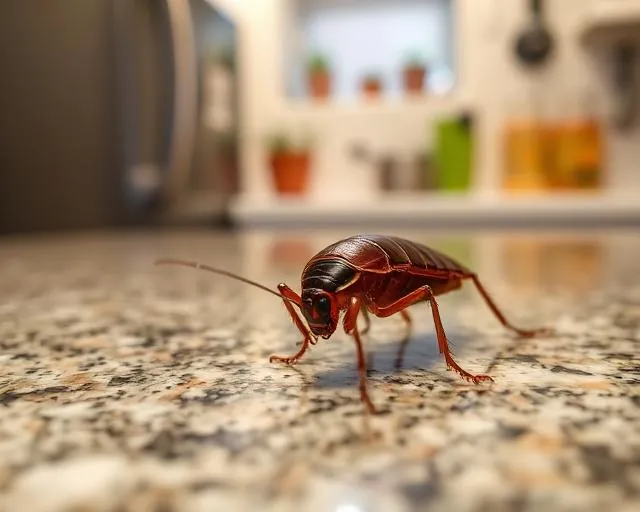
- German Cockroach: Small (1/2 to 5/8 inch), tan, with two dark parallel stripes behind head. Indoor pest of kitchens and bathrooms.
- American Cockroach: Large (1 1/2 to 2 inches), reddish-brown, with a pale yellow outer margin behind head. Outdoor/sewer peridomestic pest.
Finding a cockroach inside your home can be concerning, but different cockroach species behave in fundamentally different ways. In Texas, German cockroaches (Blattella germanica) and American cockroaches (Periplaneta americana) are two common species property owners encounter.
Because these two insects have distinct habits, habitats, and developmental rates, identifying which species you are seeing is an important first step. An American cockroach that entered from a drainage line requires a different management approach than an indoor population of German cockroaches established around kitchen appliances.
This guide provides verified entomological information based on research from the Texas A&M AgriLife Extension Service to help Texas property owners identify cockroach species, understand their habits, and know what steps to take.
Quick Comparison: German vs. American Cockroach
The primary physical and behavioral differences between German and American cockroaches include:
German Cockroach (Blattella germanica)
Small (1/2 to 5/8 inch long), tan to light brown, and distinguished by two dark, parallel stripes running lengthwise on the shield directly behind the head. In Texas, they are primarily indoor-infesting pests that aggregate in kitchens, bathrooms, and food storage areas.
American Cockroach (Periplaneta americana)
Large (1 1/2 to 2 inches long), reddish-brown, and marked by a pale yellowish border around the edges of the shield behind the head. They live primarily in high-humidity outdoor and municipal environments—such as sewer lines, storm drains, and tree bark—and occasionally enter buildings seeking moisture or shelter.
German Cockroach vs. American Cockroach Comparison Table
The following table outlines the key morphological and biological distinctions established by Texas A&M Entomology:
| Identifying Characteristic | German Cockroach (Blattella germanica) | American Cockroach (Periplaneta americana) |
|---|---|---|
| Adult Body Length | 1/2 to 5/8 inch (13–16 mm) | 1 1/2 to 2 inches (38–50+ mm) |
| Overall Body Color | Tan to light yellowish-brown | Reddish-brown to chestnut brown |
| Pronotum Markings (Behind Head) | Two dark, parallel longitudinal stripes | Pale yellowish or light brown outer margin (subtle figure-8 pattern) |
| Primary Habitat in Texas | Primarily indoor structures; warm, humid areas near food/water | Primarily outdoor high-humidity areas, sewers, drains, and tree bark |
| Common Indoor Locations | Kitchens, pantries, behind appliances, cabinet hinges, bathrooms | Utility areas, ground-floor bathrooms, floor drains, and plumbing chases |
| Flight Capabilities | Fully winged; generally do not fly (run rapidly when disturbed) | Fully winged; seldom fly, but capable of gliding flight |
| Egg Capsule (Ootheca) Habits | Female carries ootheca until shortly before eggs hatch | Female drops or glues ootheca in sheltered moist areas within days |
| Offspring per Capsule | Approximately 30 to 40 offspring | Approximately 14 to 16 offspring |
| Developmental Timing | Nymphs take ~50–60 days to mature; generation time is ~100 days | Nymphs take ~600 days to reach maturity; adults live 1 to 2 years |
| Common Texas Informal Names | Kitchen cockroach | "Waterbug", "Palmetto bug" (informal folk names) |
How to Identify a German Cockroach
The German cockroach is a widespread indoor-infesting species in residential homes, multi-family housing, and commercial food establishments.
Key Physical Characteristics
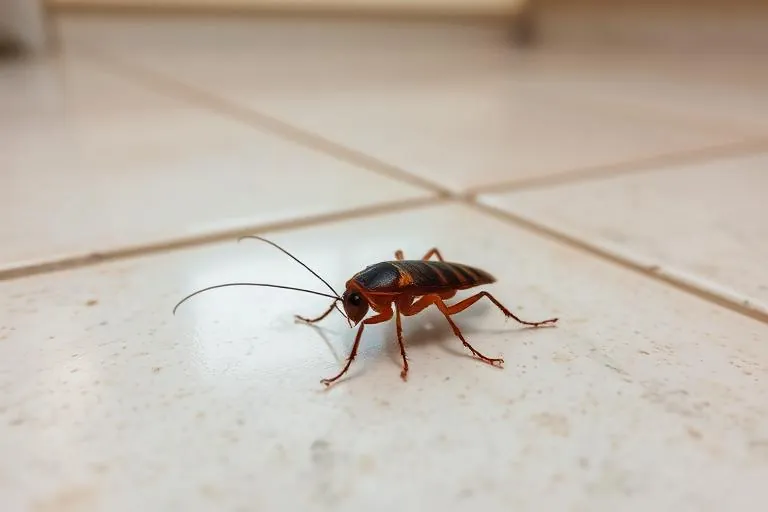
- Size: Adults are relatively small, measuring 1/2 to 5/8 inch in length.
- Two Dark Stripes: The most reliable visual identifier is the presence of two dark, parallel longitudinal stripes on the pronotum (the plate directly behind the head).
- Wings and Movement: Adult German cockroaches have fully developed wings covering the abdomen. While they are fully winged, Texas A&M entomologists note that they generally do not fly, relying instead on rapid running to seek shelter when disturbed.
Preferred Indoor Habitats
German cockroaches prefer warm, humid microclimates with immediate access to food particles and moisture. Common indoor harborages include:
- Behind and beneath kitchen appliances (refrigerators, dishwashers, microwaves, and stoves).
- Inside corners, hinges, and drawer slides of cabinetry and pantries.
- Around plumbing penetrations under bathroom and kitchen sinks.
- In small structural cracks and wall voids adjacent to heat-generating equipment.
How to Identify an American Cockroach
The American cockroach is the largest common peridomestic cockroach species found in Texas.
Key Physical Characteristics
- Size: Adults are large, typically measuring 1 1/2 to 2 inches long (and occasionally up to 2 1/8 inches).
- Pronotum Pattern: The shield behind the head is reddish-brown with a distinct pale yellow or yellowish-brown margin, creating a subtle circular or figure-8 outline.
- Wings & Flight: Both males and females possess long, well-developed wings. Texas A&M notes that while American cockroaches seldom fly, they are capable of gliding flight.
Preferred Habitats
American cockroaches are primarily outdoor and sewer-associated insects that thrive in dark, high-humidity environments, including:
- Municipal sewer systems, drainage pipes, and commercial plumbing pipe chases.
- Tree bark, decaying leaf litter, and landscape compost areas.
- Damp crawlspaces, basements, boiler rooms, and utility areas.
- Poorly sealed exterior doors, roof soffits, and foundation floor drains.

Common Misconception: Are Small Cockroaches "Baby" American Cockroaches?
A frequent point of confusion among Texas homeowners is assuming that every small cockroach seen in a kitchen is a juvenile ("baby") American cockroach. Understanding the difference between adults and nymphs is essential for accurate identification:
Adult German Cockroaches Are Naturally Small
An adult German cockroach measures only about 1/2 inch in length, but it possesses fully formed wings covering its abdomen and distinct dark head stripes.
American Cockroach Nymphs Lack Full Wings
When an American cockroach is young (a nymph), it is wingless or possesses only tiny, developing wing pads. Furthermore, an American cockroach nymph exhibits a uniform reddish-brown coloration without the two dark parallel stripes found on German cockroaches.
Identification Rule: If you see a small (~1/2 inch) cockroach that has fully developed wings and two dark stripes behind its head, it is an adult German cockroach, not a young American cockroach.
Are Large Texas Cockroaches Really "Waterbugs"?
In Texas and across the southern United States, large American cockroaches are commonly referred to as "waterbugs" or "palmetto bugs."
While this folk terminology is widespread, it is an informal common name rather than a scientific classification:
True Water Bugs (Family Belostomatidae)
True water bugs (such as giant water bugs) are predatory aquatic insects that live in ponds, lakes, and streams. They do not infest residential structures.
American Cockroaches (Periplaneta americana)
What Texans informally call "waterbugs" are true cockroaches. They earned the nickname because of their strong association with damp environments such as sewer lines, plumbing drains, and moist outdoor areas.
What Does Seeing One Cockroach Mean?
Seeing a German Cockroach Indoors
Because German cockroaches are primarily indoor pests in Texas that reproduce rapidly, seeing even one indoors deserves closer attention. Under average indoor conditions, nymphs develop into adults in approximately 50 to 60 days, and a complete generation can develop in about 100 days. While a single sighting does not definitively establish the total size of a population, daytime sightings can be associated with larger populations where primary harborages have become crowded.
Seeing an American Cockroach Indoors
A single American cockroach indoors can sometimes represent an outdoor or sewer-associated individual that entered the structure through an unsealed door threshold or plumbing opening. Texas A&M housing IPM guidance notes that water in infrequently used plumbing traps can evaporate over time, allowing cockroaches from drainage lines to move through dry P-traps into living areas. While an occasional American cockroach does not automatically indicate an established indoor population, repeated sightings warrant closer investigation.
Cockroaches, Health, and Sanitation: Objective Facts
Health & Exposure Factors
- Allergens and Asthma: According to the U.S. Environmental Protection Agency (EPA), cockroach cast skins, droppings, and saliva contain proteins that can trigger allergic reactions and asthma symptoms, particularly in sensitive individuals and children.
- Mechanical Pathogen Transfer: Texas A&M entomologists note that because cockroaches forage across floor drains, soil, and waste areas, they may mechanically transfer disease-causing organisms to food-contact surfaces.
- The "Clean Home" Reality: A widespread myth is that German cockroaches only appear in neglected homes. While accessible food crumbs and moisture support larger populations, German cockroaches can be introduced into well-maintained homes via cardboard shipping boxes, grocery bags, luggage, or movement between shared walls in multi-unit structures. Sanitation is essential for management, but cleanliness alone does not prevent an initial introduction.
Practical Observation Steps for Homeowners
If you encounter cockroaches in or around your home:
Capture or Photograph the Insect
Take a clear, close-up photograph of the insect's back under good lighting, focusing on the shield directly behind the head. An intact photo allows a pest professional to verify the species.
Note the Location and Time
Record where the insect was observed (kitchen cabinet vs. garage floor vs. bathroom drain) and whether it was seen during the day or at night.
Inspect Plumbing and Moisture Areas
Check for leaking sink pipes, run water into infrequently used floor or guest bathroom drains to maintain water in P-traps, and clear damp leaves away from exterior foundation walls.
Seal Exterior Entry Gaps
Install weatherstripping or door sweeps along exterior doors and seal openings around plumbing pipes that penetrate exterior walls or foundation slabs.
Consult a Professional
If you are seeing persistent small, striped cockroaches in kitchen areas or recurring large cockroaches entering from utility zones, professional management can help identify harborages and establish targeted treatments. Learn more about professional cockroach exterminator services in Rosenberg.
Frequently Asked Questions About German and American Cockroaches
How can you tell if a cockroach is German or American?
The easiest distinction is size and pronotum markings. German cockroaches are small (1/2 to 5/8 inch) with two dark parallel stripes behind the head. American cockroaches are large (1 1/2 to 2 inches) and reddish-brown with a pale yellowish border behind the head.
Why do German cockroaches reproduce so quickly?
German cockroach females carry an egg capsule containing approximately 30 to 40 offspring until shortly before hatching. Under average indoor temperatures, nymphs can develop into adults in about 50 to 60 days, allowing populations to expand rapidly indoors.
Can American cockroaches fly in Texas?
American cockroaches have well-developed wings and, while they seldom fly, are capable of gliding flight. German cockroaches have wings but generally do not fly.
Why do I find large American cockroaches near bathroom drains?
American cockroaches inhabit high-humidity plumbing and sewer lines. If water in a plumbing P-trap evaporates in an infrequently used bathroom or floor drain, cockroaches can move up through the dry pipe into the room.
How can I arrange cockroach services with Pest Control Rosenberg?
If you are seeing small striped cockroaches in kitchens or larger cockroaches entering your home in Rosenberg or Fort Bend County, contact Pest Control Rosenberg at (877) 665-5307 or submit an online inquiry through our contact page to discuss the activity you are seeing and available service options.
Connect with Pest Control Rosenberg
For property pest management across Rosenberg and Fort Bend County, reach out to our local team:
- Telephone: (877) 665-5307
- Online Service Inquiry: Submit an Inquiry
- Serving: Rosenberg, TX and surrounding Fort Bend County communities
- Service Solutions: Cockroach Extermination · General Pest Control · Termite Control · Commercial Pest Control
Pest Control Services We Offer in Rosenberg & Fort Bend County
- Exterminator in Rosenberg, TX
- Termite Control in Rosenberg, TX
- Rodent Control in Rosenberg, TX
- Cockroach Exterminator in Rosenberg, TX
- Mosquito Control in Rosenberg, TX
- Bed Bug Exterminator in Rosenberg, TX
- Ant Exterminator in Rosenberg, TX
- Spider Exterminator in Rosenberg, TX
- Wasp Control in Rosenberg, TX
- Flea & Tick Control in Rosenberg, TX
- Commercial Pest Control in Rosenberg, TX